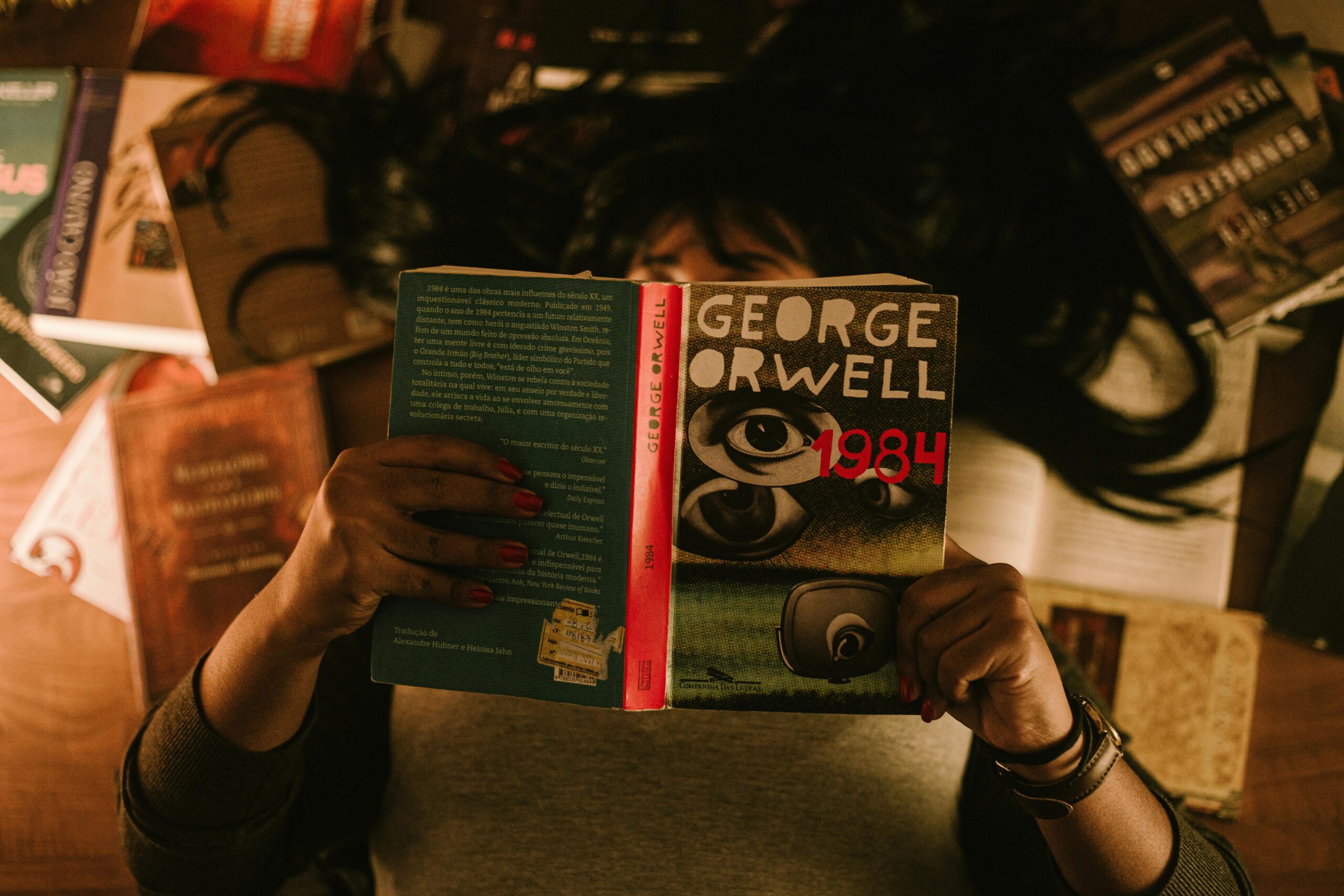
Why do societies tend to ignore historical and literary warnings about authoritarianism? As we know, history is not a sequence of isolated failures; it is a pattern of human organization, power, and collective behavior that is amplified by literature. Literature serves as a cultural memory of the patterns that are woven into our societies, and when it is ignored or suppressed, our collective ability to recognize the danger weakens.
History does not repeat itself because we fail to memorize dates or events; it repeats because societies reproduce the same social conditions, normalize the same behaviors, and forget the same warnings. As of 2020, many of the books most frequently challenged or removed from schools, such as 1984, The Handmaid’s Tale, The Hunger Games, and Fahrenheit 451, were not written to predict specific futures. They were written to expose social mechanisms by showing how control is established, how violence is normalized, and how freedoms erode gradually. These stories endure because the structures they describe are not fiction; they are an unfortunate dystopian reconfiguration of how our world could look if we let our history be suppressed.
These days, we are not failing to learn from history because the warnings are unclear, but because the social systems that are set in place are bound to normalize their return. The books that once showed and exposed us to these patterns are now dismissed when they are more relevant than ever.
Fiction as a Cultural Memory
 Literature functions as a form of cultural memory, preserving lessons that formal institutions often fail to carry forward. While textbooks record what has happened and the chosen things the government wants the people educated on, fiction explores how it’s felt and how ordinary people adapted to it. In sociology, history plays a critical role in shaping how societies come to understand themselves.
George Orwell’s 1984 examines how language shapes reality, a concept that sociologists describe as the social construction of knowledge. When words are restricted or redefined, the range of possible thought narrows. In a similar way, Ray Bradbury’s Fahrenheit 451 portrays a society that eliminates books not simply for the aspect of control over the people but to maintain social conformity and avoid discomfort.
Both of these narratives reflect a broader sociological truth: power is most effective when it becomes invisible, embedded in norms rather than enforced through constant forces. Authoritarian systems have historically recognized this, from state-controlled education in the Soviet Union to book burnings in Nazi Germany. Controlling the narrative has been a primary method of maintaining dominance. The fear is not about the information itself, but what information enables — comparison, critique, and imagination.
Censorship as Social Control
 Censorship is often misunderstood as an isolated act rather than a social process. From a sociological standpoint, it can be believed that censorship functions to define the boundaries of acceptable thought, and over time these boundaries are internalized. People begin to self-censor, not because they are forced to, but because deviation carries social consequences.
In The Handmaid’s Tale by Margaret Atwood, information is restricted to some people to maintain the rigid social hierarchy in this deeply unsettling dystopian world. In this world, they believe that education is dangerous because knowledge enables autonomy. Which mirrors historical examples in which literacy and education were denied to certain populations, like in Civil Rights America, to preserve existing power structures.
What makes censorship particularly effective is its gradual normalization. Once a society accepts that some ideas are too dangerous to encounter, the principle of open inquiry dissipates, and the loss is rarely dramatic enough to provoke immediate resistance.
Violence and the Normalization of Harm
It is safe to say that violence does not become widespread simply because people become cruel. It becomes possible when harm is reframed as necessary, justified, or routine.
 In recent news, President Donald Trump announced the Patriot Games, a competition that would take 2 young athletes from each state as a celebration of the 250th anniversary of the U.S. on July 4th. This has drawn a lot of criticism when put in comparison to Suzanne Collins’ The Hunger Games, as it illustrates how competitive violence can be transformed into a spectacle and used to reinforce social order and distract from systemic inequality.
Unfortunately, this has historical precedents, as public executions, gladiatorial games, and even modern warfare propaganda serve to distance audiences from the suffering that is endured while reinforcing authority. This can also be seen in Orwell’s Animal Farm, where violence is justified as protection of the collective, even as it increasingly benefits only those in power.
These are all patterns that can be seen across many revolutions, where initial ideals give way to bureaucratic violence once institutions prioritize survival over accountability.
This process of dehumanization is key here, because once groups are framed as threats rather than people, the moral boundaries of people shift, and violence becomes easier to tolerate when responsibility is diffused across systems, policies, and procedures.
The Gradual Loss of Freedom
One of the most consistent warnings across dystopian literature is that freedom is rarely taken all at once. Instead, it is surrendered incrementally. In Orwell’s 1984, constant surveillance became the norm. In The Handmaid’s Tale, rights are removed step by step, each justified as temporary or necessary.
 Historically, this process is well documented; the expansion of emergency powers in times of crisis often leads to permanent reductions in civil liberties. Psychologists describe this as the normalization of deviance: practices once considered unacceptable slowly become the routine as societies adjust to a new baseline.
So as restrictions become embedded in institutions, resistance becomes harder. Social inertia — the tendency to accept existing conditions as inevitable — takes hold.
Why Societies Fail to Learn
The message trying to be put forward is that the failure to learn from our history is not primarily a moral one; it is structural. Educational systems often present history as a completed story rather than an ongoing one. Fiction is then dismissed as imaginary rather than instructional.
Comfort and stability reduce perceived risk, making early warning signs easier to ignore. Institutions tend to reward conformity and predictability, not disruption. As a result, the very mechanism designed to preserve order can also suppress critical awareness.
Reading as Sociological Awareness
Reading banned or challenged books is not an act of rebellion — it is an act of recognition. These stories cultivate what sociologists call critical consciousness: the ability to see beyond surface explanations and recognize patterns of power and control.
These books do not tell us what will happen; they show us how it happens. When societies stop engaging with their warning stories, they do not become safer or more stable. They become less aware of the forces shaping them. History does not return because it must — but because we allow the conditions for its return to persist. Ultimately, the warnings are still available. Whether we choose to learn from them remains a social choice.
Conclusion
To summarize, societies do not repeat the errors of history because the warnings are hidden or unclear; they are repeated because the embedded social systems within our society normalize the very conditions that the warnings describe.
When censorship becomes routine, when violence becomes justified, and freedoms are surrendered incrementally, the changes rarely feel dramatic enough to show resistance. The literature that is often dismissed as fiction has long mapped these processes, showing not what will happen, but how it happens.
Ignoring these stories does not make the lessons obsolete; it makes the consequences more likely, seeing as our greatest advantage in the modern world is that we have decades of literature at the tips of our fingers.
Mercado is a guest blogger at UITAC Publishing. UITAC’s mission is to provide high-quality, affordable, and socially responsible online course materials.
Images used in this blog:
- “A person reading a book” by Edward Eyer is free to use under the Pexels license. This image has not been altered.
- “Kirjaston aarteita” by Petri Haanpää is free to use under the Unsplash License. This image has not been altered.
- “Trying to think of and photograph the triggering words of 2023” by Mick Haupt is free to use under the Unsplash License. This image has not been altered.
- “Three fingers Salute” by Pyae Sone Htun is free to use under the Unsplash License. This image has not been altered.
- “Woman in yellow shirt” by Umid Akbarov is free to use under the Unsplash License. This image has not been altered.